You've invested thousands into your gambling site, the design looks sharp, the games are live, the licensing is in order. But when you search for your target keywords on Google, you're nowhere to be found. Meanwhile, competitors with seemingly inferior sites are sitting comfortably on page one.
So why is your gambling site not ranking?
The short answer: Google treats gambling sites differently than almost any other vertical. The long answer involves a tangled web of technical shortcomings, content gaps, authority deficits, and regulatory scrutiny that most operators underestimate. And here's what most SEO guides won't tell you, in 2026, ranking a casino site isn't just about backlinks and keywords anymore. Google's ranking system fundamentally boils down to two core signals: Quality (Q*) and Popularity (P*). Everything else feeds into those. Q* is a site-wide trust score that Google calculates once and applies across your entire domain. If your site looks sketchy, you're dead before you start. P* uses roughly 13 months of user behavior data from Chrome, tracking whether people actually find what they need on your site or bounce back to search results. NavBoost knows if users are satisfied, and siteAuthority, which is very much real, is based on how many people search for your brand name directly.
While everyone's obsessing over traditional ranking factors, the actual game is becoming an entity that Google trusts through real user satisfaction and brand recognition. That said, you still need to nail the fundamentals. This guide breaks down every major reason your gambling site isn't ranking and gives you a concrete path to fix it.
Key Takeaways
- Your gambling site is not ranking because Google treats iGaming as a YMYL category, demanding far higher trust, compliance, and authority signals than most other industries.
- Google's ranking system in 2026 heavily weighs brand recognition (siteAuthority) and real user behavior from Chrome data, so driving traffic from social media, influencers, and PR can boost rankings even before building links.
- Technical SEO issues like slow load times, crawlability errors, and poor mobile optimization silently kill rankings on casino sites with heavy scripts and dynamic content.
- Thin or duplicate game pages, keyword cannibalization, and non-compliant content are among the most common content mistakes preventing gambling sites from reaching page one.
- Link building in iGaming requires topically relevant, high-quality sources, PBNs and irrelevant links won't move the needle and can trigger manual actions or algorithmic penalties.
- A realistic SEO strategy for a gambling site takes 12+ months of sustained effort across technical fixes, original content, strategic link acquisition, and brand-building to compete with established operators.
How Search Engines Treat Gambling Sites Differently
If you're coming from a less regulated industry, the level of scrutiny Google applies to gambling sites might catch you off guard. iGaming falls squarely into what Google considers a YMYL (Your Money or Your Life) category, which means the bar for ranking is significantly higher than it is for, say, a recipe blog or a SaaS landing page.
Google doesn't just want to see good content and a few links. It wants proof that your site is legitimate, compliant, and genuinely useful to the people clicking through. That means regulatory compliance, valid licensing, responsible gambling information, and transparent ownership details all factor into whether your site gets any visibility at all.
Understanding what iGaming SEO actually involves is the first step, because generic SEO knowledge won't cut it here.
Regulatory Restrictions and Advertising Limitations
Here's the thing most operators don't fully appreciate: many jurisdictions impose strict regulations on how and where gambling sites can advertise. Google Ads has its own layer of restrictions on top of that. Paid channels are either limited or entirely blocked depending on your market.
This is precisely why organic SEO is so critical for gambling sites. It's often your primary, sometimes your only, scalable channel for acquiring traffic through search engines. But this creates a brutal competitive dynamic. Every serious operator in your market is pouring resources into SEO because they have to. The result? A hyper-competitive landscape where half-measures get you absolutely nowhere.
And it's not just about Google's policies. Individual countries have their own advertising codes. The UK Gambling Commission, Malta Gaming Authority, and various state-level regulators in the US all impose constraints that affect what you can say, where you can say it, and to whom. If your site runs afoul of any of these, even inadvertently, you're not just risking a ranking penalty. You're risking removal from the index entirely.
Trust Signals Google Expects From iGaming Sites
Google evaluates gambling sites through the lens of E-E-A-T: Experience, Expertise, Authoritativeness, and Trustworthiness. But for gambling, Trust is doing the heaviest lifting.
Specifically, here's what Google looks for:
- Clear licensing information displayed prominently, not buried in a footer link nobody clicks
- Responsible gambling resources, self-exclusion tools, deposit limits, links to problem gambling organizations
- Author transparency, who's writing your content, and do they have verifiable industry expertise?
- Brand signals, are people searching for your brand name directly? Are you mentioned across forums, media outlets, and review platforms?
- Quality backlinks from reputable, topically relevant sources
That last point about brand signals is more important than most people realize. Google's siteAuthority metric is directly tied to how many people search for your brand. So if nobody knows your name, you're fighting an uphill battle no matter how many links you build. We've personally seen new client sites that drove tons of traffic from social media, influencers, and external sources get insane boosts in rankings for huge keywords, with practically no links. The traffic itself, and the brand recognition it generated, moved the needle dramatically.
Technical SEO Issues Holding Your Casino Site Back
Technical SEO might not be glamorous, but it's the foundation everything else sits on. And gambling sites tend to have more technical complexity than the average website, dynamic content, geo-restricted pages, multiple language versions, heavy JavaScript, and payment integrations all create opportunities for things to break.
If Google can't properly crawl, render, and index your pages, nothing else matters. Your content could be world-class and your link profile pristine, none of it helps if the pages aren't making it into the index.
Crawlability, Indexing, and Site Speed Problems
Start with the basics. Is your sitemap submitted and up to date? Are important pages blocked by robots.txt or accidentally noindexed? You'd be surprised how often casino sites have critical revenue pages that search engines simply can't reach because of a misconfigured directive.
Site architecture matters enormously here. Gambling sites often have thousands of pages, individual game pages, promotions, blog posts, landing pages for different markets. If your internal linking structure is flat or disorganized, crawl budget gets wasted on low-priority pages while the ones that actually matter languish undiscovered.
Then there's speed. Gambling sites are notorious for slow load times because of heavy graphics, video content, live odds feeds, and third-party scripts. Every second of additional load time increases bounce rates, and in 2026, we're seeing strong evidence that Chrome traffic behavior (how users interact with your pages through Chrome specifically) is a powerful ranking signal. If users land on your page and immediately bounce because it took four seconds to load, that's actively hurting your rankings through Google's behavioral signals.
The timeline for seeing results from technical fixes varies, but understanding how long it takes to rank a casino site can help you set realistic expectations and budget accordingly.
Mobile Optimization and Core Web Vitals
Mobile gambling has exploded. A huge portion of your users, likely the majority, are accessing your site from a phone. If your mobile experience is clunky, slow, or frustrating, you're losing both users and rankings.
Google's Core Web Vitals remain a ranking factor, and they're particularly relevant for gambling sites that tend to load heavy interactive elements. Focus on:
- Largest Contentful Paint (LCP): Your main content should load in under 2.5 seconds
- Interaction to Next Paint (INP): The site should respond to user interactions quickly, critical for sites with live betting or game interfaces
- Cumulative Layout Shift (CLS): Nothing should jump around the page as elements load, which is a common problem with ad placements and dynamic banners
Test your pages regularly with PageSpeed Insights and don't just check the homepage. Test your game pages, your registration flow, and your deepest content pages. Those are often where the worst performance issues hide.
Content Problems That Prevent Gambling Sites From Ranking
Content is where a lot of gambling sites fall apart, and not because operators don't produce it, but because they produce the wrong kind.
Thin, Duplicate, or Non-Compliant Content
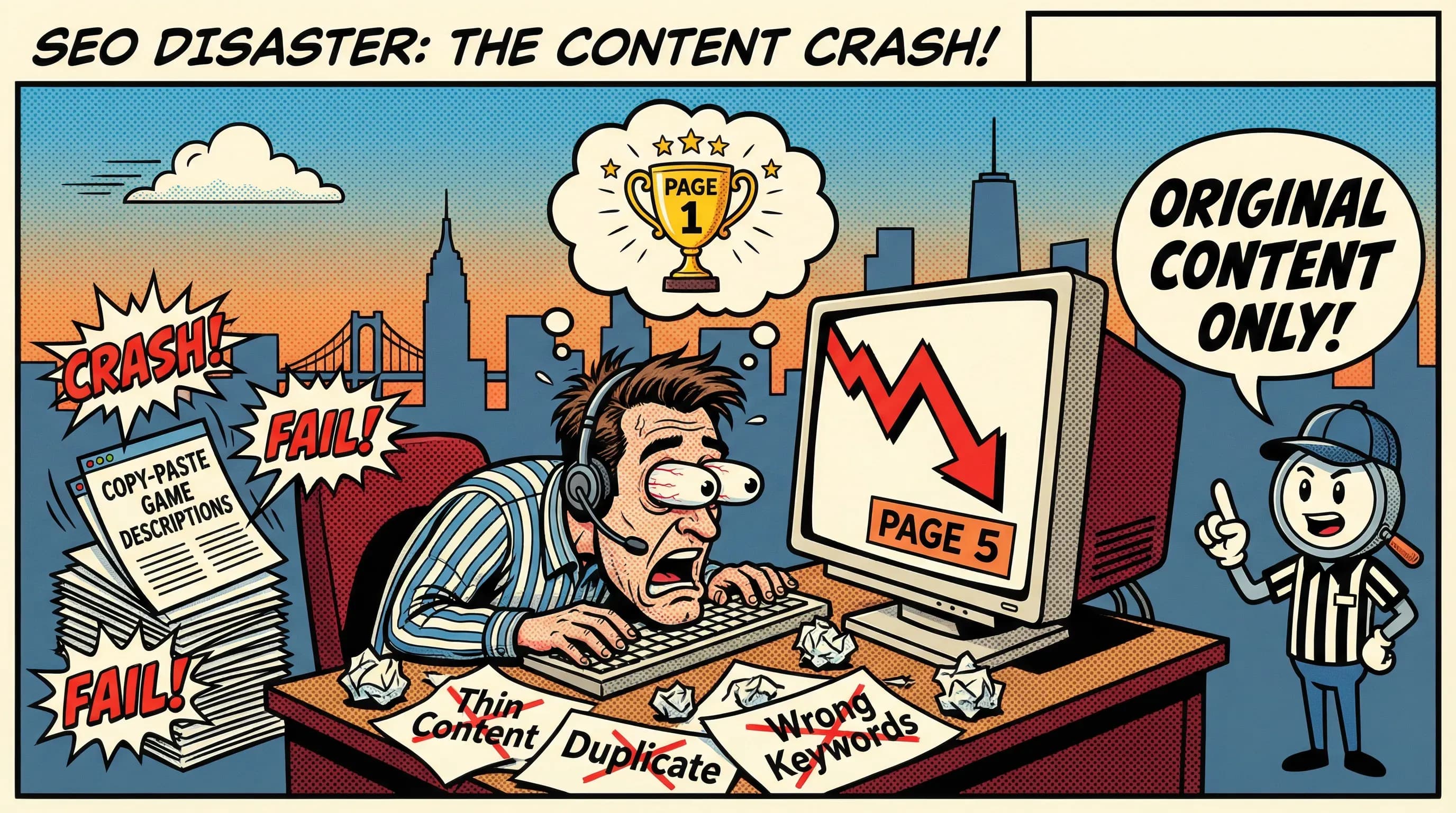
Google has gotten ruthless about thin content, and gambling sites are some of the worst offenders. Think about how many casino sites have nearly identical pages for each slot game with nothing more than a title, a brief description pulled from the game provider's press kit, and an embed. That's thin content. And when every other casino site has the same description from the same provider? That's duplicate content too.
What Google wants to see instead:
- Original game reviews with genuine analysis, strategy tips, and expert opinions
- Statistical breakdowns, RTP analysis, volatility comparisons, payout structures explained
- User-focused guides that answer actual questions players have
- Expert interviews and industry commentary that demonstrate real experience
Content compliance is another landmine. If your content makes promises about winnings, lacks responsible gambling disclosures, or targets minors in any way, Google will suppress it. Period. Every piece of content on a gambling site needs to be reviewed through a compliance lens.
Building topical relevance across your entire site also matters more than you might think. If you publish tons of content related to what you're trying to rank for, you build up sitewide relevance. The more relevance you have compared to competitors, the easier it becomes to rank. Relevance is tightly connected with topical authority, and in competitive verticals like iGaming, it can be the difference between page one and page five.
Targeting the Wrong Keywords in a Hyper-Competitive Niche
Here's a mistake we see constantly: new or mid-sized gambling sites targeting head terms like "online casino" or "best slots" right out of the gate. These keywords are dominated by massive brands with enormous link profiles and decades of domain authority. You're not going to outrank them with a six-month-old site, no matter how good your content is.
The smarter approach is targeting mid-volume, long-tail keywords that align with specific user intent. Think:
- "Best low volatility slots for beginners" instead of "best slots"
- "Is [specific casino name] legit" instead of "online casino reviews"
- Geo-specific queries like "legal online poker in Michigan"
- Informational queries that capture players earlier in their journey
If you want to learn the full playbook, our guide on ranking your online casino on Google walks through keyword strategy in much more detail.
Backlink and Authority Gaps in the Gambling Vertical
Let's talk about links, because in the gambling vertical, they're still one of the most important ranking factors. But they're also one of the hardest to get right.
Websites rank thanks to authority, and authority is largely dictated by how many quality links point to your site. You can have some lower-authority links in the mix, but a profile stuffed with only spammy, low-quality links won't move the needle in competitive niches. The main ranking factor remains links. Then there's relevance, and it's going to be very challenging to rank a site just through links if the site has no topical relevance with the terms it's trying to rank for.
Why Most Link Building Strategies Fail for Gaming Sites
Most generic link building approaches simply don't work for gambling sites. Here's why:
Outreach rejection rates are sky-high. Many publishers have editorial policies against linking to gambling content. Others are in jurisdictions where gambling promotion is illegal. Your outreach emails get ignored or declined at much higher rates than in other industries.
PBNs are a minefield. Private blog networks are common in the gambling space, but Google has gotten extremely good at identifying them. Most PBNs block crawlers from tools like Semrush and Ahrefs, making them hard to audit. And here's the kicker, ideally you want links from websites that have never been penalized, even if the penalization happened a year ago. That's hard to verify with PBN links.
Irrelevant links don't transfer authority effectively. The website linking to you needs to be topically connected to your site or at least have strong topical authority on your topic. A link from a random tech blog that published one gambling article doesn't carry the same weight as a link from an established iGaming publication.
The link also needs context. The linking page needs related content. It needs some traffic, because if Google doesn't even crawl the linking site, the link won't provide value. And ideally, the linking site has a history of publishing high-quality content, not spammy AI-generated posts that'll get penalized sooner or later.
Earning High-Quality Links in a Restricted Industry
So what actually works? Here's what we've seen drive real results:
- Contact the current top-ranking sites for your target keywords and do whatever it takes to get featured. Sometimes it requires a financial arrangement, sometimes a referral partnership or even a full brand partnership. It depends on the niche, but getting cited on pages that already rank is incredibly powerful.
- Build informational sub-brands. You could build multiple informational sites, create topical authority on them, earn links naturally, and then leverage those properties to boost your main brand. Yes, it takes time and significant effort, but are you serious about competing with multi-million dollar brands or not?
- Create genuinely linkable assets, original research, industry reports, infographics with real data, interactive tools like odds calculators or bankroll managers
- Strategic guest posting on reputable gaming blogs, industry publications, and news outlets
- Influencer collaborations within the gambling and gaming space that generate both links and brand awareness
Remember: in 2026, having tons of Chrome traffic flowing to your pages makes them rank faster and better. Chrome traffic appears to be a very strong signal, especially when combined with links and relevance. So link building strategies that also drive real referral traffic are doubly valuable.
On-Page SEO Mistakes Specific to Casino and Betting Sites
On-page SEO for gambling sites has its own set of pitfalls that go beyond generic best practices.
Title tags and meta descriptions. Many casino sites either stuff their titles with keywords ("Best Online Casino | Top Casino | Play Casino Games Online") or write them so generically they don't differentiate from competitors. Your title tag should include your primary keyword naturally while compelling a click. Your meta description should sell the click with specific value propositions, not just repeat the title in longer form.
URL structure. Keep URLs clean, descriptive, and short. /slots/starburst-review is better than /games/category/slots/page?id=4829. Gambling sites with complex CMS setups often generate ugly URLs by default, fix this.
Header hierarchy. Proper H1-H6 tag usage helps both users and search engines understand page structure. Every page should have exactly one H1, and subheadings should follow a logical hierarchy. Don't skip from H2 to H4 because you liked the font size better.
Keyword cannibalization. This is rampant on gambling sites. You've got a blog post targeting "best online slots," a category page targeting "best online slots," and a promotional landing page also targeting "best online slots." Google doesn't know which one to rank, so it ranks none of them well. Audit your content, consolidate overlapping pages, and give each page a distinct keyword target.
Internal linking. Most casino sites drastically underutilize internal links. Your highest-authority pages (usually the homepage and top-level category pages) should pass link equity down to the pages you're trying to rank. Create deliberate internal linking pathways, don't just rely on navigation menus.
Schema markup. Carry out relevant structured data, review schema, FAQ schema, game schema where applicable. This won't directly boost rankings, but it can improve click-through rates from the SERPs, which feeds back into Google's behavioral signals.
If you're considering building a casino affiliate site as part of your strategy, getting on-page fundamentals right from day one saves enormous headaches down the road.
Penalties, Manual Actions, and How to Recover
If your gambling site was ranking and then suddenly dropped, or if it's never ranked even though seemingly doing everything right, you might be dealing with a penalty or manual action.
Google issues manual actions for gambling sites more frequently than many other verticals. Common triggers include:
- Unnatural link profiles, a sudden influx of low-quality or paid links that trip Google's spam detection
- Thin content at scale, hundreds of near-identical game pages with minimal unique value
- Cloaking or deceptive redirects, showing different content to Googlebot than to users, which some gambling sites still try
- Regulatory non-compliance, promoting gambling services in markets where you're not licensed
- User-generated spam, forums or comment sections overrun with spam that you haven't moderated
Check Google Search Console for any manual action notifications. If you have one, here's the recovery path:
- Identify the specific violation cited in the manual action notice
- Fix the underlying issue, disavow toxic links, remove or improve thin content, correct technical violations
- Document everything, Google wants to see that you've made genuine, thorough changes
- Submit a reconsideration request with clear evidence of what you've fixed and what processes you've put in place to prevent recurrence
- Wait, reconsideration can take weeks or even months, and there's no guarantee of full recovery
Even if you don't have a formal manual action, algorithmic penalties can be just as devastating. These don't show up in Search Console, they're the result of core algorithm updates that reassess quality signals across your site. If your rankings dropped around the time of a major Google update, that's your likely culprit.
The fix for algorithmic hits is the same as the fix for manual actions, just without the reconsideration request: improve quality across the board, clean up your link profile, and invest in the kind of legitimate authority signals we've discussed throughout this article.
Building a Long-Term SEO Strategy for Your Gambling Site
Here's the uncomfortable truth: there's no quick fix for gambling site ranking issues. If anyone tells you they can get your casino site to page one in 30 days, they're either lying or they're going to get you penalized.
A real, sustainable SEO strategy for a gambling site in 2026 looks like this:
Months 1–3: Foundation
- Complete technical audit and fix all crawlability, indexing, and speed issues
- Audit existing content and eliminate thin, duplicate, or non-compliant pages
- Establish proper on-page optimization across all key pages
- Set up tracking and reporting infrastructure
Months 3–6: Content and Authority Building
- Begin publishing high-quality, topically relevant content on a consistent schedule
- Start strategic link acquisition from topically connected, reputable sources
- Build brand awareness through social, PR, and influencer partnerships to drive Chrome traffic and brand searches
- Identify and pursue partnerships with top-ranking sites in your target SERPs
Months 6–12: Scaling
- Expand content coverage to build deeper topical authority
- Increase link building velocity while maintaining quality standards
- Optimize based on user behavior data, which pages retain users, which ones bounce
- Consider building informational sub-brands to own more SERP real estate
Months 12+: Domination
- Target progressively more competitive keywords as authority grows
- Leverage your SERP presence to influence AI-generated answers (ChatGPT, AI Overviews, etc. pull from top-ranking content)
- Continuously monitor competitor movements and algorithmic changes
The brands that win in iGaming SEO aren't the ones that find a clever hack. They're the ones that commit to building genuine authority, driving real traffic, and satisfying actual users. Google's entire system is designed to reward exactly that.
If you want expert help navigating this, working with a specialized iGaming SEO agency that understands the unique challenges of this vertical is often the difference between spinning your wheels and actually climbing the rankings.
Conclusion
If your gambling site isn't ranking, it's almost certainly not one single problem. It's a combination of technical gaps, content shortcomings, authority deficits, and the inherent difficulty of competing in one of the most scrutinized verticals on the internet.
But here's what should give you hope: most of your competitors are making these same mistakes. The operators who methodically address each of these areas, who build real authority, earn genuine trust signals, and create content that actually serves users, are the ones who break through.
Stop thinking about SEO as a checklist of tricks. Start thinking about it as building a brand that Google has no choice but to rank. Drive real traffic from every channel you can. Make people search for your brand name. Keep users on your site because your content genuinely helps them. Do all of that consistently, and the rankings will follow.
The game hasn't changed as much as people think. It's just gotten more honest about what it rewards.
Frequently Asked Questions
Why is my gambling site not ranking on Google?
Your gambling site likely isn't ranking due to a combination of technical SEO issues, thin or duplicate content, weak backlink profiles, and insufficient trust signals. Google classifies gambling as a YMYL (Your Money or Your Life) category, applying far stricter scrutiny than most industries. Low brand recognition and poor user behavior signals from Chrome also play a major role.
How does Google evaluate trust for iGaming and casino websites?
Google evaluates gambling sites through E-E-A-T, with Trust carrying the most weight. It looks for clear licensing information, responsible gambling resources, expert-authored content, quality backlinks from topically relevant sources, and strong brand signals. Specifically, Google's siteAuthority metric is tied to how many users search for your brand name directly.
How long does it take to rank a gambling site on Google?
Ranking a gambling site typically requires 6 to 12 months of sustained effort. The first three months focus on technical fixes and content audits, months three through six on content publishing and link acquisition, and months six to twelve on scaling authority. Timelines vary based on competition, budget, and niche factors.
What are the most common SEO mistakes casino sites make?
The most common mistakes include targeting overly competitive head terms like 'online casino,' publishing thin or duplicate game pages, keyword cannibalization across multiple pages, neglecting internal linking, and relying on low-quality or PBN backlinks. Poor mobile optimization and slow site speed also significantly hurt rankings in this vertical.
Does driving traffic from social media or influencers help gambling site rankings?
Yes, significantly. Driving Chrome traffic from social media, influencers, and external sources generates brand recognition and positive user behavior signals that Google tracks through NavBoost. Sites with strong external traffic have seen major ranking boosts for competitive keywords, even with minimal backlink profiles. This strategy builds the brand authority Google rewards.
What kind of backlinks actually work for gambling websites?
Effective backlinks for gambling sites come from topically relevant, reputable sources with real traffic and a history of quality content. Links from established iGaming publications, industry news outlets, and pages already ranking for your target keywords carry the most weight. Avoid PBNs and spammy link profiles, as Google penalizes gambling sites more aggressively than most verticals.